
What is Classical Education?
Classical Education is the truth about everything. It is taking new students on old paths, paths which are well-worn, proven, and timeless. Classical education is the truth about reality as a whole and how all things and ideas are integrated, and ultimately united, in the mind and work of our Creator. We study the full scope of the Western tradition, from the ancient to the modern, from philosophy to science, from scholars to saints. And in all this we seek the ancient triad of truth, goodness, and beauty, which ultimately reside in and lead to our Triune God. As a classical Catholic school based in the liberal arts tradition, we empower students in the art of living well as well as gaining mastery in the five academic competencies: thinking well, speaking well, reading well, writing well, and listening well. It is these, we believe, in faithfulness and obedience to Christ, which lead to true freedom and human flourishing.
Classical Education follows the natural stages of child development for age-appropriate learning: the grammar stage, the logic stage, and the rhetoric stage.
Grammar Stage - Pre-K through 4th
This is where education all begins as we start with the basics of learning and knowledge. This stage is rooted in a natural curiosity for the world. Scholars are curious about the world around them while learning colors, grammar, reading and basic math. This stage encompasses the natural tendency of the toddler to ask “What?”, and Classical Education answers this basic question through exploring the world around them through math, literature, writing, history, science, nature, and our Catholic catechesis.
Scholars are learning how to learn and how to exhibit behavior and conduct which are both expected and beneficial. This includes what it means to be involved intellectually with a subject through memorization and observation as well as physically with a subject through incarnational and tactile learning.
Logic Stage - 5th through 7th
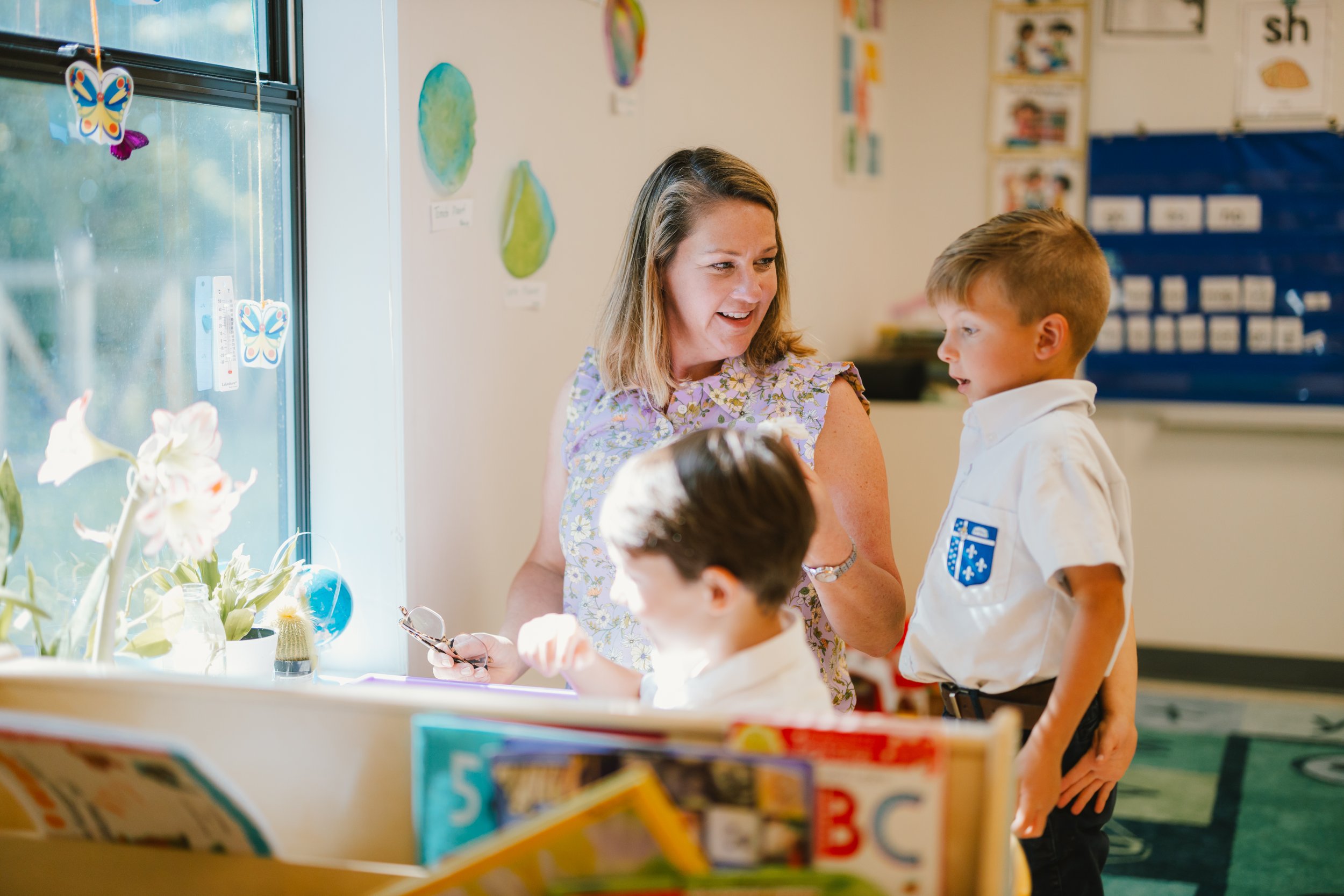
In this stage, scholars are beginning to think more analytically and ask the question “Why?” This is where deeper more philosophical knowledge is gained. Scholars are encouraged to pursue their natural propensity to argue, critique, judge, and question boundaries, seeking Truth for themselves. They no longer accept that which is merely told or commanded of them but instead desire to test and to think critically. The classroom fosters this natural progression to question and allows them to engage in logical thinking.
Scholars are learning to categorize, organize, and integrate information by exploring basic cause-and-effect relationships, how basic parts and skills relate to one another and their lives, and how different disciplines build upon and relate to one another.

Rhetoric Stage - 8th through 12th
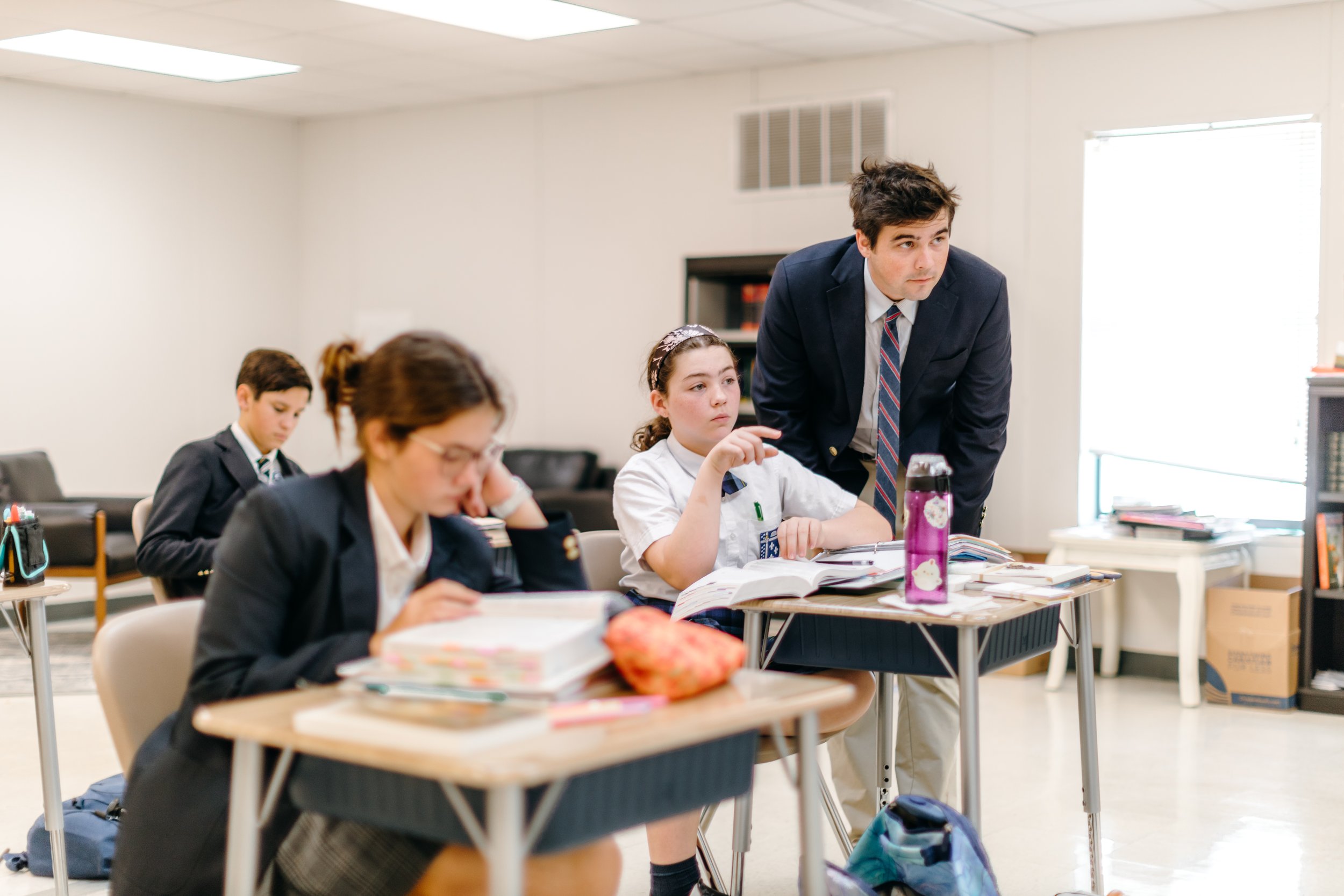
Rhetoric is defined as “the art and science of a good man persuasively speaking,” and that is the summation of this stage of development. Here is the more polished training and virtues of effective communication, communication which doesn’t just present one’s personal opinion or self-expression but which presents the truth beautifully and persuasively, whether the medium is words, art, or actions. This stage is where scholars put all of their years through Classical Education together. They have built upon their foundation of knowledge and are now using this to propel themselves forward onto the stage of academic thought and reason. Here scholars are encouraged to speak their mind in class through Socratic Seminar, building self-confidence, authority, and articulation in the scholar.
Scholars advance through mathematical, scientific, and language skills in the Socratic dialogue format as they begin to step into a life of authentic freedom and wisdom. These skills, knowledge, habits, and virtues will benefit them and their communities, laying the firmest foundation for their future and God-given vocations.
Frequently Asked Questions
-
Our classical curriculum prepares scholars for life! This includes college, trade school, and the workforce. Most importantly, we prepare our scholars for their God given vocation. Our school's goal is not to be a college prep school; instead, we aim to be a Heaven prep school. Our ultimate goal in life is to reach Heaven, so our aim and focus remains here. Scholars will be prepared for whatever vocation God wills for their lives, but most importantly they will be equipped with the skills necessary to do life well.
-
We do not offer any 1-to-1 technology use within the classroom. This is not to say technology is not useful, but all things should be utilized in its proper place. Our high school students will have assignments that require the use of a computer but this is done at home with the assistance of the parents. We believe parents are the primary educators of their children and we aim to assist parents as much as we possibly can in this great endeavor.
-
As our patron G.K. Chesterton quipped, "Latin is not dead. It is immortal." It is true that classical Latin is no longer the national language of any country. Far from being a "dead language," however, Latin lives on in the Romance languages, much of English vocabulary, and scientific nomenclature. Furthermore, Latin is the language of Holy Mother Church--in her liturgy, daily use, and official documents.
Practically speaking, there are three main types of benefits in studying Latin:
1.) Intellectual Formation--Grammar/Language Benefits
In studying Latin, students are studying language as a whole, not only this one particular language but how words work, the grammar of all other languages. The regularity, order, and predictability of Latin help students to better understand Latin and English grammar, perhaps without realizing it.
2.)Spiritual Formation--Discipline
As students learn Latin, they are forming more than their minds. The study of Latin requires attention to detail, accuracy, patience, precision, and thorough, honest work. These qualities are invaluable in student formation. Their Latin studies also enable and compel students to more fully participate in the life of the Church.
3.) Human Formation--Unity & Integration in the Western Tradition
As a Classical School, we engage the Western Tradition. We accept and sift through those things which have been handed down from the ages; preserve what is true, good, and beautiful; and pass those lasting things down to our students. Latin is the language that binds the curriculum together. It is impossible to preserve a civilization apart from its language. In God's providence, Western Civilization has been handed down to us in the language of Latin. It is the Cardinal Study. Just as the Cardinal Virtues (Latin root cardo, door hinge/pivot point) are the virtues upon which all other virtues “hinge,” Latin is the study upon which the other disciplines hinge.
The study of Latin is intentionally included in our curriculum to bring together the three pillars of formation: intellectual, spiritual, and human. We introduce Latin in a fun, interactive way in lower school to spark interest and provide a grammatical foundation. Latin studies continue through upper school to build upon this foundation and deepen their understanding so that students may ultimately sentīre cum ecclesiā (think with the Church).
-
At Holy Trinity Academy, math and science is more than the study of facts and formulas—it is the study of God’s creation. From the vastness of the stars to the intricacies of living organisms, students are invited to explore the natural world with curiosity, humility, and awe.
Science is the study of the physical world, that is, of God’s creation. None of the subjects taught here at Holy Trinity Academy can be approached without a sense of wonder. It is fitting, therefore, to begin by looking up at the Heavens, at the lights in the sky: Astronomy. Then we take a look at the world God created (Geology), the creatures He created (Biology), and the intricate substances of which all things are made (Chemistry). We end by gaining an understanding of the nature and properties of matter and energy (Physics).
-
Beauty is essential to a complete education.
Visual art teaches students more than technique. It cultivates creativity, careful observation, and the ability to express ideas with clarity and purpose. At the same time, students learn to recognize and thoughtfully evaluate great works of art, developing an appreciation for the beauty that has shaped Christian culture and Western civilization.
A complete education must include the development of the creative nature and must provide students with the tools and technique with which to express their ideas, their feelings and their love. It must also include the analytical skills with which to judge a work of art and exposure to great art. Finally, the mechanical skills and aesthetic aptitude must be put into the proper context of eternal Truth. A good artist is a complete thinker and vice versa. The influence of the arts in today’s society cannot be overstated, and this is why art is mandatory at Chesterton Academy all four years.
-
Students aren’t just called to know facts... they’re called to seek wisdom.
Philosophy teaches students to ask life’s greatest questions: What is truth? What is justice? What does it mean to live well? In wrestling with these questions, they learn to think clearly, reason carefully, and pursue what is true with both faith and intellect.
At Chesterton Academy, students study the rich tradition of philosophy from Plato and Aristotle to St. Thomas Aquinas, discovering how faith and reason work together to illuminate reality. Along the way, they strengthen the habits of logical thinking that enrich every discipline—from literature and history to mathematics and the sciences.
A classical Catholic education is about more than preparing students for college. It is about forming young men and women who can think deeply, live wisely, and seek truth throughout their lives.
-
Yes! We are accredited through the Chesterton Schools Network. The Chesterton Schools Network of Catholic Classical schools has recently become international, and colleges are starting to take notice of the students that Chesterton high schools are graduating. Universities are beginning to offer scholarships just for holding a Chesterton School diploma.